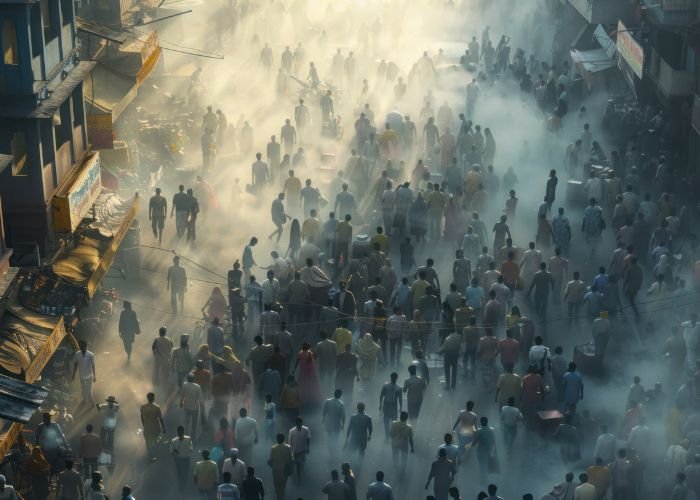
The Hathras Stampede 2024
On July 2, 2024, a tragic stampede at a Hindu religious event in the Hathras district of Uttar Pradesh led to the deaths of 123 people, primarily women and children, and resulted in the hospitalization of at least 150 others. The calamity took place during a satsang in the village of Mughal Garhi, where an estimated 250,000 attendees vastly exceeded the permitted number of
80,000. The incident unfolded as the crowd was dispersing from the makeshift tent, set up in a muddy paddy field approximately 500 meters from a highway. The event was organized by the ‘Sri Jagar Guru Baba organization’, led by the local preacher Shri Suraj Pal, also known as Narayan Sakar Hari or Bhole Baba. Shri Suraj Pal is a former constable with the Uttar Pradesh Police and has a significant following among the Dalit community.
According to various accounts, the stampede began when attendees jostled to catch a glimpse of Pal, with some attempting to gather soil or dirt from around his feet. Other reports indicate that the crowd was halted to allow Pal and his entourage to leave first. In the ensuing chaos, some victims reportedly fell into a roadside drain, while others were trampled as they were seated or crouching on the ground.
Reasons of such tragedies
Stampedes can arise in different situations, such as religious gatherings, food or relief distributions, entertainment events, escalators, footbridges, sports events, political rallies, riots, fires during events, and natural disasters.Unidirectional stampedes typically occur when the crowd reacts to a sudden trigger, such as a barricade stopping their movement or a loud noise that causes everyone to rush in one direction. Whereas, turbulent stampedes are more dangerous and happen when two crowds moving in opposite directions merge or when a stationary crowd suddenly panics.
Once a stampede begins, controlling the mass of people becomes extremely challenging, often resulting in numerous casualties within seconds. Effective management of large crowds is crucial, as even minor lapses can lead to stampedes. With urbanization and population growth, mass gatherings are more frequent, necessitating a shift from traditional “crowd control” to comprehensive “crowd management.” This requires strategic planning at all levels, from the event venues to district and state disaster management frameworks. The National Disaster Management Authority (NDMA) has developed an integrated approach to address crowd and disaster management effectively.A thorough Hazard, Risk, and Vulnerability Analysis (HRVA) of mass gathering venues is essential. This analysis should form the basis for strategies encompassing all three phases of any severe incident: response, recovery, and mitigation.
The Disaster Management Act,2005
The Disaster Management Act of 2005 (DMA 2005) was enacted by the Indian government to efficiently manage disasters and related issues. Comprised of 11 chapters and 79 sections, it was signed by the President of India on December 23, 2005. The act is founded on the principle that mitigating disaster-related losses is more effective than spending on relief and rehabilitation. The DMA 2005 establishes several governing bodies:
1. National Disaster Management Authority (NDMA): Chaired by the Prime Minister of India and comprising up to nine members, including a Vice-Chairperson, all serving five-year terms. The NDMA’s primary responsibility is to establish policies, plans, and guidelines for disaster management to ensure an effective response to disasters.
2. National Executive Committee (NEC): The Central Government, under the DMA, can create the NEC to support the NDMA. The NEC includes Secretary-level officers from ministries such as home, health, power, finance, and agriculture. It is tasked with preparing and annually updating the National Disaster Management Plan.
3. State Disaster Management Authority (SDMA): Each state’s disaster management plan is developed by the SDMA, led by the Chief Minister and comprising eight members appointed by the Chief Minister. Under Section 28, the SDMA ensures that all state departments create disaster management plans in line with national and state guidelines.
4. District Disaster Management Authority (DDMA): The DDMA is chaired by the district’s Collector, District Magistrate, or Deputy Commissioner, and is responsible for managing disasters at the district level.
5. National Disaster Response Force (NDRF): The NDRF is responsible for responding to imminent disasters or similar situations. Led by a Director-General appointed by the Central Government, the NDRF has been instrumental in rescue operations during significant events, such as the Kashmir floods in 2014 and the Kerala floods in 2018.
National Disaster Management Authority (NDMA) Guidelines on Crowd Management at Events and Venues of Mass Gathering
●According to the NDMA Guidelines the initial step involves regulating traffic around pandals and Dussehra grounds. Route maps for pedestrians indicating paths to the venue and emergency exits should be displayed at key locations.
●Barricades are essential to ensure orderly movement in queues, and should be used effectively in managing large crowds.
●CCTV cameras should be installed to monitor crowd movement, and police presence should be increased to reduce the risk of petty crimes such as snatching.
●Unauthorized parking and makeshift stalls that encroach on pedestrian spaces should be addressed as well.
●To handle medical emergencies in crowded spaces, an ambulance and healthcare professionals should be on standby. This can be crucial in saving lives during critical situations.
●Unplanned and unauthorized electrical wiring at pandals, LPG cylinders at food stalls, and hidden crackers in Ravana effigies pose significant fire hazards. These can be deadly in densely packed crowds.Organizers should ensure authorized use of electricity, have fire extinguishers on hand, and meet all safety guidelines.
●Knowing the locations of nearby hospitals is also crucial. Simple precautions like wearing light, cotton clothing and knowing how to roll on the ground to extinguish fire are important safety measures.
Conclusion
The Hathras tragedy will always be remembered as a dark chapter in history, it serves as a reminder for our government to learn from the past mistakes and bring positive changes. Even after around 70 years of the bloodied Allahabad Kumbh Mela Stampede we’re unable to manage and mitigate such tragedies. It’s a clear question upon the Disaster management tactics and the on ground response of our administration. The most tragic aspect of incidents like these is their preventability through proactive administration. In the past such incidents have occurred due to the ill planning and mismanagement on the side of the administration and the organizers of various events. Sadly, authorities in many states have not heeded past lessons or utilized advanced technology and communication effectively. Beyond holding those responsible, accountable, the Uttar Pradesh administration should ensure a fair compensation package, funded by the event organizers. This tragedy underscores the critical need for effective crowd management strategies. Officials must ensure that organizers are equipped to manage large gatherings and conduct drills before such events. The NDMA Guidelines should be effectively seen to be complied by various stakeholders including the ordinary citizens. Also, the training methods of the security and critical support personnel should be reformed and made such which enables them to help people out of the least in the face of the worst. Moreover, political leaders, bureaucrats, and event organizers must remember that each life lost is a profound tragedy for the family affected. This awareness should drive the planning and execution of mass gatherings.
Written by- Harsh Shukla, 3rd Year BALLB, DES’s Shri Navalmal Firodia Law College, Pune